Pilgrimage Holiday Destinations in India
India is home to some of the world's oldest continuously practised pilgrimage traditions. Here's where they happen, and what to expect if you visit as a traveller rather than a pilgrim.
By Dhruv Poonia, Digital & Marketing Manager, Colourful Indian Holidays · Published 1 August 2026
Already know you want this trip? Skip ahead and tell us your dates.
India's pilgrimage sites aren't museum pieces — they're still in daily use, which is exactly what makes them remarkable to visit. You're not looking at a recreation of a ritual; you're watching the same ceremony that has happened at that spot for centuries, still happening tonight, performed by people for whom it is a genuine act of devotion rather than a show staged for visitors. For international travellers, that authenticity is the draw, but it also means visiting respectfully matters more here than almost anywhere else on a typical India itinerary — these are living religious sites, not heritage attractions repurposed for tourism. India's religious landscape is genuinely diverse, spanning Hindu, Sikh, Buddhist and Muslim traditions that have coexisted and, in many cases, physically overlapped for centuries — Ajmer's Sufi shrine and Pushkar's Hindu temples sit fifteen kilometres apart, and the Golden Temple's hospitality extends to visitors of every background without exception. Below is a guide to India's most significant pilgrimage destinations, what a visit to each actually involves, and the practical etiquette worth knowing before you go, so you can experience these places as a respectful observer rather than an intruder on someone else's sacred moment.
If you'd rather browse this as a set of bookable itineraries than read through the full guide first, our Pilgrimage Tours page rounds up Spiritual India, the Kumbh Mela, the Ajmer Urs, the Rishikesh Yoga Festival and the Pushkar Fair as a single browsable landing page, each with a direct enquiry option.
Varanasi — The Ganges Ghats
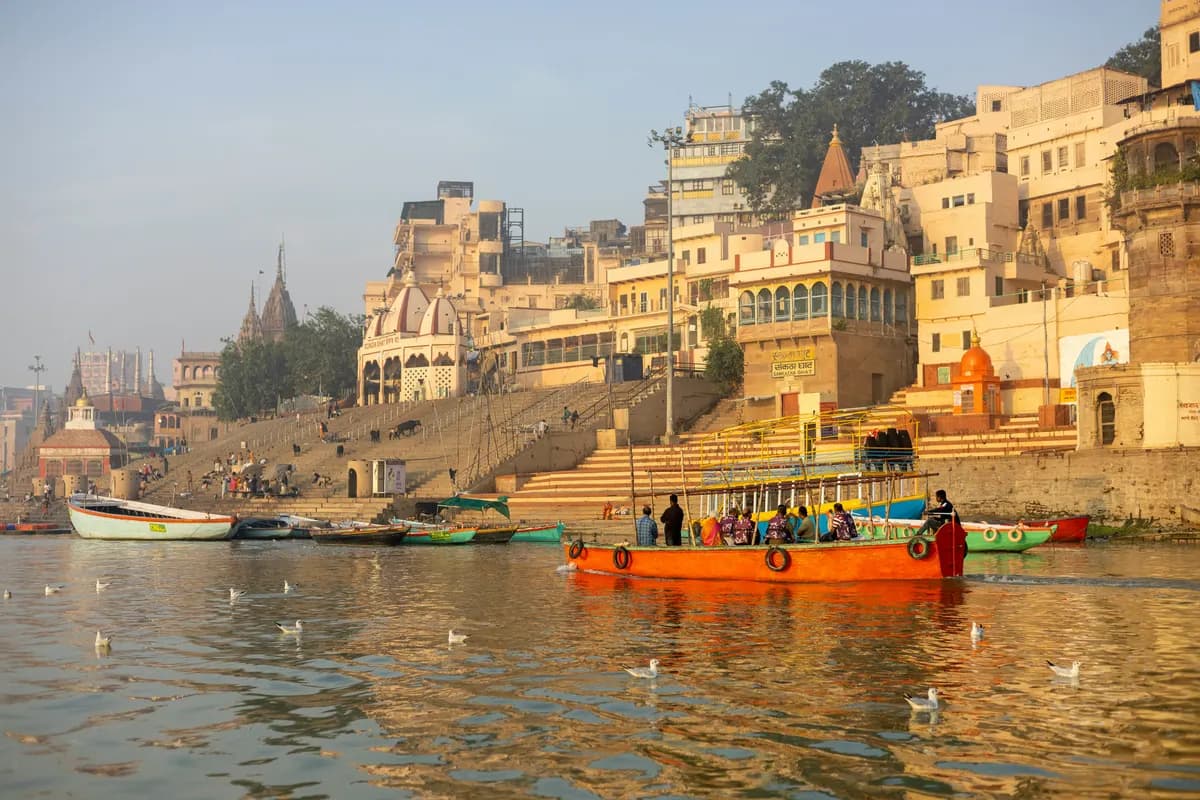
Varanasi is the single most significant Hindu pilgrimage city in India, and among the oldest continuously inhabited cities in the world, built along the western bank of the Ganges. Hindus believe dying in Varanasi, or having one's ashes scattered in the Ganges here, brings moksha — liberation from the cycle of rebirth — which is why the city has drawn pilgrims for millennia and why its ghats (riverside steps) remain in continuous daily use for bathing, prayer, and cremation rites. The evening Ganga aarti — a fire ceremony performed by a row of priests at Dashashwamedh Ghat every night at sunset, with drums, chanting, and dozens of flames moving in unison against the darkening river — is the reason most visitors come, and it's genuinely one of the most striking things you can watch anywhere in India.
Beyond the evening ceremony, a sunrise boat ride along the ghats shows a completely different side of the city — quieter, and full of people bathing, praying, and washing laundry as the sun comes up over the river, with the city's skyline of temples and old buildings silhouetted behind them. The Kashi Vishwanath Temple, one of the twelve Jyotirlinga shrines dedicated to Shiva and among the most significant Hindu temples anywhere, sits a short walk from the main ghats and was recently connected to the riverfront by the newly built Kashi Vishwanath Corridor, a wide pedestrian plaza that has made the walk between temple and ghats considerably more atmospheric than it once was. A short trip outside the city to Sarnath, where the Buddha delivered his first sermon after attaining enlightenment, adds a Buddhist counterpoint to Varanasi's intensely Hindu character, and is a common half-day add-on for travellers with an extra day to spare. International visitors researching India's spiritual heritage often arrive in Varanasi expecting only the famous ghats, and leave surprised by how much the city itself — its narrow lanes, its centuries-old silk-weaving tradition, and its role as a centre of Sanskrit learning — adds beyond the pilgrimage sites alone. See our full Varanasi destination guide for more on the city beyond its pilgrimage sites, or our Heritage Tours itinerary, which pairs Varanasi with Khajuraho's temple carvings and Sarnath in a single 5-day circuit.
Rishikesh & Haridwar — Where the Ganges Begins
A few hours north of Delhi, Rishikesh and Haridwar sit where the Ganges leaves the Himalayan foothills and enters the plains — a geographically and spiritually significant transition point that has made this stretch of river sacred for as long as Hindu pilgrimage to the Ganges has existed. Haridwar's Har Ki Pauri ghat hosts its own nightly Ganga aarti, on a smaller and more intimate scale than Varanasi's, and is also the primary site of the Kumbh Mela when the festival rotates through the city once every twelve years, drawing tens of millions of pilgrims over its duration. Rishikesh, just upstream and framed by forested hills rather than Haridwar's flatter plains setting, has become India's best-known yoga and meditation centre, home to numerous ashrams — including the one made famous by the Beatles' 1968 visit — and is worth building into a trip even if pilgrimage itself isn't your primary interest, since the town also offers river rafting, suspension-bridge crossings over the Ganges, and a genuinely relaxed pace after busier stops elsewhere on an itinerary. International visitors specifically drawn to India's wellness and yoga traditions often extend their stay here beyond a simple day trip, since several ashrams and yoga centres in Rishikesh offer short courses and retreats that welcome foreign visitors without requiring any prior experience. Our Spiritual India itinerary pairs Rishikesh and Haridwar with Amritsar's Golden Temple, and if your dates align with early March, the International Yoga Festival fills the town with practitioners from dozens of countries. Haridwar is also one of four rotating host cities for Kumbh Mela, worth knowing if your travel year happens to line up with an edition there. For travellers curious about India's wider pilgrimage landscape, our Rishikesh & Haridwar destination guide covers the practical side of visiting in more depth — where to stay, how to get around, and what else fills out a few days here.
The Char Dham Yatra — Uttarakhand's Four Himalayan Shrines
Most journeys to the Char Dham Yatra begin exactly where the section above leaves off — Rishikesh and Haridwar are the traditional gateway towns, with Rishikesh in particular serving as the yatra's main transit camp each season. The Char Dham circuit itself is a different order of pilgrimage from anything else on this page: four high-altitude Himalayan shrines — Yamunotri, Gangotri, Kedarnath and Badrinath — reachable only during a roughly seven-month window each year, when winter snow closes the mountain routes for the remainder. In 2026, the temples opened in their traditional sequence between April 19 and April 23 and close again around mid-November, ahead of the next winter.
The pilgrimage follows a fixed order: Yamunotri first (3,293m, reached via a 5 to 6km trek from Janki Chatti, with ponies and palanquins available for those who don't walk it), then Gangotri (3,100m, directly road-accessible via Uttarkashi), then Kedarnath (3,583m, the most physically demanding of the four, requiring a 16 to 18km uphill trek from Gaurikund, though a helicopter service also operates), and finally Badrinath (3,133m, again road-accessible). The full circuit by road from Delhi covers roughly 1,500 to 2,000km and typically takes 10 to 12 days.
This is worth being direct about: the Char Dham Yatra is overwhelmingly a domestic Hindu pilgrimage rather than an international tourist circuit, and recent years have added registration requirements — including biometric ID verification — that are built around India's domestic identity system and aren't straightforwardly set up for foreign nationals. We haven't built this into a standard package for that reason. If you have a genuine, specific interest in the Char Dham Yatra as part of a longer trip, it's worth a direct conversation with us about what's realistically involved for your situation, rather than assuming it works the same way as the other pilgrimage destinations on this page.
Amritsar — The Golden Temple
The Golden Temple (Harmandir Sahib) is Sikhism's holiest site, and one of the most welcoming religious sites in India for visitors of any faith or background. Built in the late 16th century by the fourth Sikh Guru, Guru Ram Das, and later gilded with gold leaf in the early 19th century under Maharaja Ranjit Singh, the temple is open 24 hours, entry is free, and — in keeping with core Sikh principles of equality and hospitality — the temple runs the world's largest free community kitchen, the langar, which feeds upwards of 50,000 people a day regardless of religion, caste, or nationality. Visitors are genuinely invited to sit on the floor and eat alongside everyone else, an experience many international travellers describe as one of the most moving moments of their entire India trip.
The temple itself, gold-plated and set within a large reflecting pool known as the Amrit Sarovar (Pool of Nectar), is at its most striking either early in the morning or after dark, when the crowds thin and the lighting changes — the gold facade lit up against the night sky is a genuinely different sight from its daytime appearance. A short distance away, the Wagah Border ceremony — a daily, highly choreographed flag-lowering display at the India–Pakistan border, performed with theatrical marching and crowd participation on both sides — is a popular late-afternoon add-on for travellers spending a full day in Amritsar, though it's a very different kind of experience from the temple itself, more spectacle than spirituality. The Golden Temple also makes a striking setting during Diwali, when it's illuminated and reflected in the Amrit Sarovar — one of the most photographed Diwali scenes anywhere in India. See our Spiritual India itinerary for a trip built specifically around Amritsar, Haridwar and Rishikesh together, or our Amritsar destination guide for more on the city itself.
Pushkar — Rajasthan's Holy Lake
Pushkar is built around a sacred lake ringed by more than 50 ghats, and is home to one of the very few temples in India dedicated to Brahma, the creator god — a genuine rarity, since despite Brahma's prominence in Hindu cosmology, temples dedicated to him are exceptionally uncommon compared to those for Shiva or Vishnu. Hindu mythology holds that the lake formed where a lotus petal fell from Brahma's hand as he performed a yagna (fire ritual) here, which is why the town carries such deep religious significance despite its modest size. It's a smaller, more low-key pilgrimage stop than Varanasi or Amritsar, which makes it an easy add-on to a Rajasthan itinerary rather than a destination requiring a special trip of its own — most travellers visit as a natural stop between Jaipur and Jodhpur or Udaipur rather than a dedicated pilgrimage journey. If your timing lines up with the Pushkar Fair, held each autumn, you'll see the town at its most colourful, with tens of thousands of camels, traders and pilgrims filling the surrounding desert for the event. Pushkar and Ajmer pair naturally with the forts and palaces covered in our Rajasthan monuments guide. See our Pushkar destination guide for more on the town itself.
Ajmer — Ajmer Sharif Dargah
A short drive from Pushkar, Ajmer is home to the Dargah of Khwaja Moinuddin Chishti, one of the most important Sufi shrines in South Asia and a major pilgrimage site for Muslims across the region and beyond. The dargah marks the tomb of the 12th-century Sufi saint, and in Sufi tradition, a saint's death anniversary — known as an Urs — is marked with celebration rather than mourning, since it's understood as the saint's union with the divine. The annual Urs festival draws large crowds for six days of qawwali (devotional music) performances and prayer. Visitors of any background are welcome at the dargah year-round, not just during the Urs, and many travellers combine Ajmer with Pushkar as a single day trip from Jaipur, since the two towns sit only around 15 kilometres apart.
Bodh Gaya — Where the Buddha Attained Enlightenment
Bodh Gaya, in the state of Bihar, is the single most important pilgrimage site in Buddhism — it marks the exact spot where Siddhartha Gautama attained enlightenment beneath a Bodhi tree, becoming the Buddha. The Mahabodhi Temple, a UNESCO World Heritage Site dating in its current form to the 5th–6th century (with earlier structures on the same site dating back to Emperor Ashoka in the 3rd century BCE), stands beside a descendant of the original Bodhi tree, and draws Buddhist pilgrims from across Asia, particularly from Sri Lanka, Thailand, Myanmar, Japan, and Tibet. Unlike Varanasi or Amritsar, Bodh Gaya sits well off the standard North India circuit, which means it typically requires a dedicated add-on rather than a natural stop between other destinations — but for travellers with a specific interest in Buddhist heritage, it's considered essential rather than optional.
Tirupati — India's Most-Visited Pilgrimage Site
Tirupati, in Andhra Pradesh, is home to the Venkateswara Temple, dedicated to a form of Vishnu — and by sheer visitor numbers, it's the single most-visited religious site in India, drawing tens of millions of pilgrims annually, more than most of the country's more internationally famous sites combined. The temple sits atop the Tirumala hills, and the pilgrimage itself is part of the tradition — many devotees climb the hill on foot as an act of devotion rather than taking the road. It's considerably further south than the other destinations on this list and sits outside the typical North India and Rajasthan circuit most first-time international travellers build their trip around, but it's worth knowing about for anyone planning a longer South India itinerary or with a specific interest in seeing one of the world's busiest religious sites firsthand.
Shirdi — The Sai Baba Temple
Shirdi, a small town in Maharashtra, draws millions of pilgrims each year to the Samadhi Mandir, the shrine built over the resting place of Sai Baba of Shirdi, a 19th-century saint venerated by Hindus and Muslims alike for teaching that all paths lead to the same divine truth. Unlike many of India's older pilgrimage traditions, devotion to Sai Baba is a comparatively recent phenomenon that has grown enormously over the past century, and Shirdi today functions almost entirely around pilgrim infrastructure — accommodation, prasad (blessed food) counters, and a well-organised queue system for darshan (viewing the shrine) that can still involve a significant wait during peak periods and festivals. It's a further-flung addition for most international itineraries, sitting a few hours from Mumbai or Pune, but travellers building a Maharashtra-focused trip, or with a specific personal connection to Sai Baba's teachings, often make the detour deliberately rather than as an afterthought.
Vaishno Devi — The Mountain Shrine in Jammu
Vaishno Devi, in the Trikuta Hills near Jammu, is one of the most-visited Hindu pilgrimage sites in India, drawing several million pilgrims a year to a cave shrine dedicated to the goddess Vaishno Devi, an incarnation of the divine feminine. Unlike most sites on this list, reaching the shrine is itself part of the pilgrimage — a roughly 12-kilometre trek uphill from the base at Katra, undertaken on foot, by pony, palanquin, or helicopter for those short on time or mobility. The physical effort involved is, for many devotees, part of the spiritual significance of the visit rather than an inconvenience to be minimised. For international travellers, Vaishno Devi is a genuinely different kind of pilgrimage experience from the ghats of Varanasi or the Golden Temple — more physically demanding, set in cooler mountain terrain rather than a riverside or desert town, and best suited to travellers who specifically want that combination of trek and shrine rather than those looking for an easy add-on to an existing circuit.
Visiting Respectfully — A Note for International Travellers
Each of these sites is, first and foremost, a place of active worship rather than a tourist attraction that happens to have religious significance, and the distinction matters in how you carry yourself while visiting. Speak quietly, avoid pointing cameras directly at people who are actively praying, and follow your guide's lead on when it's appropriate to take photographs versus when it's better to simply watch. Most people at these sites are genuinely welcoming to respectful visitors — the langar at the Golden Temple exists specifically because hospitality to strangers is a core value, not despite it — but that welcome depends on visitors understanding they're guests at someone else's sacred practice, not spectators at a performance staged for them.
A knowledgeable local guide makes this much easier to navigate respectfully. See our Spiritual India itinerary
Best Time to Visit These Sites
Timing varies by destination more than most first-time visitors expect. Varanasi and Rishikesh & Haridwar are most comfortable October through March, when temperatures are milder and the Ganges is at a manageable level for boat rides and bathing ghats alike — summer months bring intense heat, and the monsoon can raise river levels significantly. Amritsar follows a similar pattern, with winter offering the most comfortable conditions for the queues and courtyard walking the Golden Temple visit involves. Pushkar is at its liveliest during the autumn Camel Fair, typically in October or November, while Ajmer's Urs festival timing shifts annually according to the Islamic lunar calendar, so it's worth checking exact dates if you specifically want to experience it. Bodh Gaya sees the largest crowds around the Dalai Lama's winter teachings, usually in December or January, and is considerably quieter outside that window. Tirupati and Shirdi draw heavy pilgrim traffic year-round regardless of season, so visitor volume there is less a matter of timing and more something to plan around directly, with early-morning visits generally the least crowded option. Vaishno Devi is best avoided during the height of summer heat and the monsoon months, when the uphill trek becomes considerably more demanding — the cooler months from September through March suit the physical trek far better.
How Pilgrimage Sites Fit Into a Wider India Itinerary
Very few international travellers build an entire trip solely around pilgrimage destinations — more commonly, one or two of these sites become a meaningful thread woven through a wider India itinerary that also covers forts, wildlife, and cities. Varanasi pairs naturally with a Golden Triangle extension, since it's a comparatively short flight from Delhi or Agra and adds a spiritual and cultural dimension that the Taj Mahal and Jaipur's palaces, as remarkable as they are, don't on their own provide. Pushkar and Ajmer, as noted, slot directly into a Rajasthan circuit as a natural stop between Jaipur and the state's western cities, adding very little extra travel time for a genuinely different kind of experience from forts and palaces. Rishikesh and Haridwar work well as a northern extension for travellers who want to pair Delhi and the Golden Triangle with the Himalayan foothills, particularly if yoga, meditation, or river rafting also interest you beyond the pilgrimage sites themselves. Amritsar, being close to the India–Pakistan border in Punjab, is most often combined with a northern circuit that also includes Delhi and sometimes Dharamshala, rather than tacked onto a Rajasthan-only trip. Bodh Gaya, Tirupati, Shirdi and Vaishno Devi each sit further from the standard first-timer circuit and are better suited to travellers on a longer trip, a repeat visit to India, or those with a specific personal or spiritual reason to prioritise that particular site over convenience.
When we build an itinerary that includes pilgrimage destinations, the sequencing matters as much as the site list itself — visiting Varanasi's ghats at dawn after arriving late the previous night rarely does the experience justice, so we build in enough time around each stop for it to land properly rather than squeezing it between other commitments. The same goes for physically demanding sites like Vaishno Devi, where arriving with a day already behind you changes how much you get out of the trek itself.
Let us handle the sequencing and logistics for you. See our Pilgrimage Tours
Planning a Pilgrimage-Focused Trip
A few practical things worth knowing before you build these into an itinerary:
- Dress modestly at all of these sites — shoulders and knees covered is a safe baseline, and headscarves are required for women at some temples and gurdwaras
- Shoes come off before entering most temples and the Golden Temple complex, and are usually left at a designated counter rather than carried in
- Photography is restricted or banned inside many inner sanctums — always check before raising a camera, and never photograph cremation rites at Varanasi's ghats without explicit permission
- Evening aartis draw genuine crowds; arriving 30–45 minutes early secures a good spot, particularly at Varanasi and Haridwar during peak season
- A private guide who can explain the ritual you're watching makes a real difference to how much of it actually makes sense in the moment, rather than looking on without context
- At the Golden Temple, head coverings are required for everyone regardless of gender — scarves are provided free at the entrance if you don't have your own
- Alcohol, meat, tobacco and non-vegetarian food are prohibited within many temple precincts, including the Golden Temple complex and the town of Pushkar itself — check local norms before you arrive rather than assuming standard rules apply
- At Vaishno Devi, pony, palanquin and helicopter options exist for travellers unable to manage the full trek on foot — worth arranging in advance during peak pilgrimage season, when demand for these options rises sharply
- Security screening is standard at most major pilgrimage sites, including the Golden Temple and Vaishno Devi — build a little extra time into your schedule around entry, particularly during festivals or peak season
Getting to each of these sites varies considerably in ease. Varanasi, Amritsar and Rishikesh & Haridwar all have their own airports or sit within a comfortable drive of one, making them straightforward to fold into a wider itinerary. Pushkar and Ajmer are easily reached by road from Jaipur, typically as a same-day or overnight addition to a Rajasthan circuit. Bodh Gaya, Tirupati, Shirdi and Vaishno Devi require more deliberate planning — additional flights, longer road transfers, or in Vaishno Devi's case, the trek itself — which is exactly why we recommend deciding early in the planning process whether one of these sites is a priority for your trip, so the rest of the itinerary can be built around it rather than squeezed in as an afterthought.
One final note worth keeping in mind across every site on this list: India's pilgrimage destinations draw pilgrims first and tourists second, which is precisely the opposite of how most famous monuments and attractions function. That ordering is what makes these places feel genuinely alive rather than preserved for visitors, and it's also why patience, quiet observation, and a willingness to let a local guide set the pace tend to produce a far more rewarding visit than trying to see everything on your own schedule.
Frequently Asked Questions
Do non-Hindu or non-religious travellers visit these sites too? Yes, regularly. Most of these sites — the Golden Temple especially — actively welcome visitors of every background, and the ceremonies themselves are striking to witness regardless of your own beliefs. Respectful curiosity is generally met with genuine warmth.
Can international travellers do the Char Dham Yatra? Technically yes, but it's worth going in with the right expectations — the registration process is built around India's domestic ID system, the terrain is physically demanding at high altitude, and the circuit runs on a fixed seasonal window (roughly late April to mid-November). It's a fundamentally different kind of trip from the other destinations on this page, and one worth discussing with us directly if you're genuinely interested rather than assuming it fits into a standard itinerary.
Is it appropriate to photograph ceremonies like the Ganga aarti? Generally yes for public ceremonies like the evening aarti at Varanasi or Haridwar, though always be mindful of people actively praying nearby. Cremation rites at Varanasi's ghats are a firm exception — never photograph these without explicit permission.
How many pilgrimage sites should we realistically add to a two-week India trip? One or two integrated naturally into your route — Pushkar and Ajmer alongside Rajasthan, or Varanasi alongside a Golden Triangle extension — tends to work far better than trying to cover several sites spread across the country, which usually means sacrificing depth elsewhere in the itinerary.
Varanasi, Rishikesh & Haridwar, Amritsar, and Pushkar can all be combined into a single wider India itinerary alongside Rajasthan and the Golden Triangle, while Bodh Gaya and Tirupati are better suited to travellers with a specific pilgrimage focus or a longer trip that extends beyond the standard North India circuit. If you'd like these built into your own trip — whether that's one or two stops added to a wider itinerary, or a journey built specifically around India's pilgrimage traditions — our team can put together a route that fits your dates and your interests.
Dhruv Poonia is the Digital & Marketing Manager for Colourful Indian Holidays, working alongside a family travel business that has arranged tours across India, Nepal and Bhutan since 2007. He also oversees the company's sister sites, Rajasthan Travel Agency and Palace on Wheels Tour.
He writes and maintains the destination guides, route information and travel advice published on this site, drawing on his day-to-day work planning itineraries for international travellers to keep every page accurate and current.
Start Your Journey
Your India, Nepal & Bhutan Journey Awaits.
Where Will You Begin?
Every itinerary is built privately around your dates and interests — tell us what you have in mind and we'll reply within 24 hours.