Monuments in Rajasthan: A Complete Guide
Rajasthan has more surviving forts and palaces than anywhere else in India. Here are the ones actually worth building a trip around.
By Dhruv Poonia, Digital & Marketing Manager, Colourful Indian Holidays · Published 1 August 2026
Already know you want this trip? Skip ahead and tell us your dates.
Rajasthan's monuments aren't spread thin across the state — they cluster in a handful of cities, which is exactly why a Rajasthan itinerary works so well as a circuit rather than a series of separate day trips bolted together. Almost every major fort or palace here was built by one of Rajasthan's Rajput ruling clans between the 8th and 18th centuries, often specifically to withstand siege — which is why so many of them still stand today, largely intact, in a way that's genuinely unusual for structures this old. For an international traveller planning a first trip through India, that density of well-preserved, still-standing history is one of the strongest reasons Rajasthan tends to anchor the whole itinerary rather than being treated as a side trip. Below is what to expect at each of the major sites, roughly in the order most first-time visitors see them, along with practical notes on timing, entry, and what a private guide actually adds at each stop.
Amber Fort, Jaipur
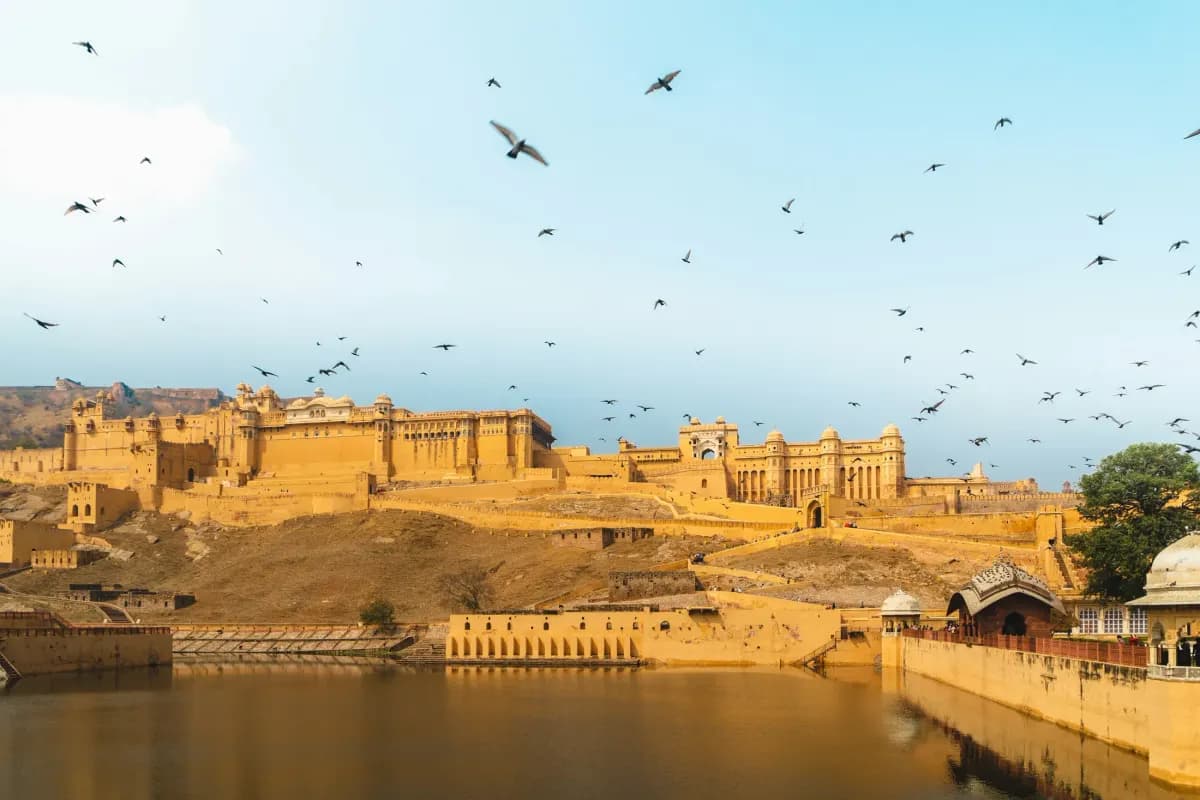
Amber Fort is usually the first major monument on a Rajasthan itinerary, and it sets the bar high — a hilltop fort-palace overlooking Maota Lake, built from pale yellow and pink sandstone and white marble, with courtyards, mirror work, and fortified walls that climb the ridgeline behind it like a smaller version of the Great Wall. Construction began in 1592 under Raja Man Singh I and continued for generations under successive rulers, which is why the fort feels less like a single building and more like a layered complex — Diwan-e-Aam (the public audience hall), Diwan-e-Khas (the private hall, with its famous mirrored Sheesh Mahal), and the Sukh Niwas pleasure palace all sit within the same walls but were built decades apart. Arrive early in the morning, both to beat the heat and the crowds, and to see the fort in the kind of soft light it was built to be seen in — the sandstone genuinely changes colour through the day. Many visitors also take a short jeep ride up to the entrance rather than climbing the ramp on foot, which is worth doing if you want to save your energy for the walk inside, since the fort itself is considerably larger than it first appears from below. Amber Fort anchors our Jaipur City Tour, alongside the other Jaipur sites covered below.
City Palace & Hawa Mahal, Jaipur
Back in the city itself, the City Palace is still partly a working royal residence — Jaipur's former royal family retains private apartments here — with several museum wings open to visitors, including the Sabha Niwas hall and an armoury displaying Rajput weaponry going back centuries. The palace blends Rajasthani and Mughal architectural styles in a way that's distinct from the more purely Rajput forts elsewhere in the state, a reflection of the alliance Jaipur's rulers maintained with the Mughal empire rather than open conflict with it. A short walk away, Hawa Mahal — the "Palace of Winds" — is famous for its honeycomb facade of 953 small windows, built in 1799 so that royal women could watch street life and processions below without being seen themselves, in keeping with the purdah customs of the era. It's a five-storey structure but startlingly shallow from behind — many first-time visitors are surprised to learn it's barely one room deep in places. It's best photographed from across the street in the early morning, when the light hits the pink sandstone directly and the street below is still quiet.
Mehrangarh Fort, Jodhpur
Mehrangarh sits on a sheer rock outcrop roughly 400 feet above Jodhpur's old blue city, and is widely considered one of the best-preserved forts in India — Rudyard Kipling once described it as "the work of giants", and standing at the base looking up, it's not hard to see why. Founded in 1459 by Rao Jodha, the fort's outer walls run up to 36 metres high in places and were never successfully breached in battle. Inside, the museum galleries — covering armour, palanquins, royal portraits, and an elaborate collection of howdahs (elephant seats) — are genuinely well curated rather than an afterthought, with an audio guide included in the entry fee that's considerably more detailed than most Indian monument audio guides. The views over the blue-washed rooftops below are reason enough to visit on their own; the blue colour, historically linked to the Brahmin caste but now used more widely across the old city, is at its most striking from the fort's upper ramparts in the late afternoon. Mehrangarh is the centrepiece of our Jodhpur Tour, which covers the fort alongside the rest of the blue city below it.
Jaisalmer Fort
Jaisalmer Fort is one of the very few "living forts" left in the world — around a quarter of the old city's population still lives within its walls, in havelis that are centuries old, running shops, guesthouses and restaurants built into the same golden sandstone the fort itself is carved from. That makes it a genuinely different kind of visit from Rajasthan's other forts: you're walking through an inhabited neighbourhood, not a preserved monument behind ropes and glass cases. Built in 1156, the fort sits deep in the Thar Desert, and its golden-yellow sandstone gives it a completely different visual character from the pink and red forts of Jaipur and Jodhpur — it glows almost amber at sunset, which is where the city's nickname, the "Golden City", comes from. Because the fort is genuinely lived-in, its long-term structural stability has become a real conservation concern in recent decades, and UNESCO has flagged it as at-risk — worth knowing if you're curious why some areas may be under restoration during your visit. Our Jaisalmer Tour covers the fort in depth, along with the city's havelis and the desert dunes beyond it.
City Palace & Lake Palace, Udaipur
Udaipur's City Palace is the largest palace complex in Rajasthan, built up over nearly 400 years by successive Mewar rulers starting in 1553, with balconies, cupolas and towers looking directly out over Lake Pichola. Because it was expanded by so many different rulers over such a long period, the architecture inside shifts noticeably as you move through it — different wings reflect different eras of taste, from heavier Rajput stonework to more delicate later additions. The Lake Palace itself — the white marble palace that appears to float on the lake, built in 1746 as a summer retreat — is now a luxury hotel, but it's worth seeing from the water even if you're not staying there; several boat tours depart from near the City Palace jetty and pass close by at sunset, when the white marble takes on a warm golden tone against the darkening lake. Udaipur is often described as the most romantic city in Rajasthan, and the view back toward the City Palace from the water is a large part of why that reputation holds up. Our Udaipur Tour covers both palaces alongside the city's other lakes and viewpoints.
Chittorgarh Fort
Chittorgarh is the largest fort in India by area — its walls enclose roughly 700 acres, including several palaces, temples and towers within a single fortified complex — and it carries some of Rajasthan's most significant history. It was the capital of Mewar for centuries and the site of three major sieges, most notably against Alauddin Khalji in 1303 and later against the Mughal emperor Akbar in 1567–68, both of which ended in jauhar, the ritual mass self-immolation of the fort's women rather than surrender — a history that's still central to how the site is understood and presented today. The Vijay Stambh (Tower of Victory), a nine-storey tower built in the 15th century to commemorate a military victory, is the fort's most recognisable structure and can be climbed for sweeping views over the surrounding plains. Chittorgarh sees far fewer international visitors than Jaipur or Udaipur, which makes it one of the better places in Rajasthan to see a major monument without the crowds — though it does mean less English-language signage on-site, so a guide adds even more value here than at the more visited forts.
Jantar Mantar, Jaipur
A UNESCO World Heritage Site in its own right, Jantar Mantar is a collection of nineteen astronomical instruments built in stone and marble between 1727 and 1734 under Maharaja Jai Singh II, an avid astronomer as well as Jaipur's founder. The instruments are still functional and, remarkably, still accurate — the largest, the Samrat Yantra sundial, can tell local time to within about two seconds. It's an easy add-on to a City Palace and Hawa Mahal morning in Jaipur, sitting directly between the two, and a guide is genuinely useful here — without an explanation, the site can look like an abstract sculpture garden rather than what it actually is: one of the most sophisticated pieces of pre-telescope astronomical engineering anywhere in the world.
Nahargarh Fort, Jaipur
Less visited than Amber Fort but arguably offering the best single view over Jaipur, Nahargarh sits on the same Aravalli ridgeline as Amber and Jaigarh forts, connected to them by a fortification wall. Built in 1734 as a defensive outpost, it's best known today for its sunset views over the Pink City spread out below, and for Madhavendra Bhawan, a palace within the fort built with nine near-identical apartments — one for each of the Maharaja's queens, so no favouritism could be perceived between them. It's a good late-afternoon add-on after a morning at Amber Fort, and considerably quieter than the more famous sites in the city.
Kumbhalgarh Fort
Kumbhalgarh is best known for one specific fact that surprises most first-time visitors: its perimeter wall runs for roughly 36 kilometres, making it the second longest continuous wall in the world after the Great Wall of China. Built in the 15th century by Rana Kumbha, the fort was considered virtually impregnable and was breached only once in its history, and even then only through a shortage of drinking water rather than direct military defeat. It sits further off the standard tourist circuit than Jaipur, Jodhpur or Udaipur, roughly midway between the two latter cities, which makes it a natural stop on a longer Rajasthan itinerary rather than a dedicated day trip from any single base.
See it as part of a longer route, not a detour. View the Grand Rajasthan Circuit
Junagarh Fort, Bikaner
Unlike most of Rajasthan's forts, Junagarh wasn't built on a hilltop — it sits at ground level, protected instead by a wide moat and thick outer walls, a deliberate departure from the hilltop-fortress tradition seen at Amber, Mehrangarh and Jaisalmer. Built between 1589 and 1594 by Raja Rai Singh, it has never been conquered, and its interior palaces — including the ornate Anup Mahal and Chandra Mahal — are notable for their extensive use of gold leaf and mirror work, some of the most elaborate in Rajasthan. Bikaner sits in the state's northwest, further off the classic Jaipur–Jodhpur–Udaipur triangle, and is more commonly paired with the Bikaner Camel Festival season or a dedicated desert-focused itinerary.
Bundi Palace & Taragarh Fort
Bundi is one of Rajasthan's most underrated stops for anyone specifically interested in monuments, and Rudyard Kipling — who also praised Mehrangarh — once wrote that Bundi Palace looked like something out of a fairy tale "that a monkey with a paintbox could have improved." Built from the 16th century onward and spilling down a hillside overlooking the town's tightly packed blue-washed houses, the palace is famous for its murals — the Chitrashala gallery in particular houses some of the finest surviving examples of Rajput miniature painting anywhere, depicting court scenes, hunting expeditions and Krishna legends in extraordinary detail. Above the palace, Taragarh Fort (the "Star Fort") offers commanding views and a genuinely atmospheric, semi-ruined feel that's different from the more fully restored forts elsewhere in the state. Bundi sees a fraction of the visitors that Jaipur or Udaipur do, which means both the palace and fort are usually explored in relative quiet — a real draw for travellers who've already covered the state's more famous sites and want something further off the standard circuit.
Ranthambore Fort
Most international visitors come to Ranthambore for the tiger safaris, but the fort that gives the national park its name is a genuine monument in its own right, and one that's easy to underrate if you're focused entirely on wildlife. Dating back to the 10th century and rebuilt and expanded over subsequent centuries, Ranthambore Fort sits atop a hill within the park itself, surrounded by the same forest that the reserve's tigers roam — a genuinely unusual combination of ancient monument and active wildlife habitat that few other sites in India offer. The fort includes several temples, including one dedicated to Ganesh that remains an active pilgrimage site, drawing devotees from well beyond Ranthambore itself, particularly during Ganesh Chaturthi. Our Ranthambore Tour builds in time for the fort alongside the safaris, adding a historical dimension to a stop most visitors otherwise treat purely as a nature experience — and if tiger sightings specifically are your priority, our Tiger Safari Tours guide covers how Ranthambore compares to Madhya Pradesh's reserves.
The Hill Forts of Rajasthan — A UNESCO World Heritage Site
Six of Rajasthan's forts — Chittorgarh, Kumbhalgarh, Ranthambore, Jaisalmer, Gagron, and Amber — are collectively inscribed as a single UNESCO World Heritage Site, the "Hill Forts of Rajasthan," recognised in 2013 for representing a distinct form of Rajput military architecture developed between the 5th and 18th centuries. UNESCO's listing specifically highlights how these forts adapted to the landscape around them — some built on isolated hilltops, others integrated into existing towns — while sharing common defensive principles: massive fortification walls, elaborate gateways designed to slow attackers, and water harvesting systems that allowed each fort to withstand prolonged sieges. Knowing that these six sites form a single recognised heritage group is useful when planning a monuments-focused itinerary, since it explains why they're treated as a natural set by guides and historians alike, even though they're spread across very different parts of the state and were built by different Rajput dynasties at different points in history.
Cover these UNESCO sites without stitching the logistics together yourself. See our Rajasthan Culture & Heritage Trail
How Much Time to Allow, and When to Go
Most of these monuments reward at least half a day each rather than a rushed hour — Amber Fort, Mehrangarh and Chittorgarh in particular have enough scale that a hurried visit means missing entire wings. If you're building a Rajasthan itinerary around these sites specifically, count on roughly 8 to 10 days to cover Jaipur, Jodhpur, Udaipur and Jaisalmer comfortably without back-to-back travel days, or closer to 12 to 14 days if you want to add Chittorgarh, Kumbhalgarh and Bikaner into the same trip. October through March is by far the most comfortable season to visit — daytime temperatures sit in a manageable range and the desert light is at its clearest — while April through June brings extreme heat that makes midday fort visits genuinely uncomfortable, and the July–September monsoon, while cooler, can bring humidity and occasional access disruptions at some sites.
Visiting Rajasthan's Monuments — Practical Notes
- Most major forts open early (around 8–9am) and are significantly more comfortable to visit before midday heat sets in, especially April through June
- A private guide at each fort makes a real difference — the history behind these sites is dense, and a good guide turns a walk through empty rooms into something much more vivid, especially at less-visited sites like Chittorgarh where English-language signage is minimal
- Comfortable, closed shoes are worth it — fort floors and stairs are uneven stone, often worn smooth by centuries of foot traffic
- Entry fees are typically higher for foreign visitors than for Indian nationals; this is standard practice across India's monuments, not specific to any one site, and is usually clearly posted at the ticket counter
- Many forts charge a separate camera fee for photography — check before entering if you plan to bring a proper camera rather than just a phone
- Some inner palace areas (particularly at Amber and City Palace, Udaipur) require a separate, additional ticket for access — a guide will typically flag these in advance so you can decide before you're at the gate
Frequently Asked Questions
How many days do we need to see Rajasthan's major monuments properly? Count on roughly 8–10 days to cover Jaipur, Jodhpur, Udaipur and Jaisalmer without back-to-back travel days, or 12–14 days if you want to add Chittorgarh, Kumbhalgarh, Bundi or Bikaner into the same trip. Rushing any of the major forts tends to mean missing entire wings, so we'd rather build in an extra day than cut one short.
Is a guide really necessary, or can we visit these forts independently? You can visit independently, but the history behind these sites is dense and often not fully conveyed by on-site signage, particularly at less-visited forts like Chittorgarh or Bundi. Most travellers find a private guide turns a walk through empty rooms into something considerably more vivid — well worth it for sites of this scale and significance.
Which Rajasthan fort should we prioritise if we only have time for one or two? Amber Fort and Mehrangarh are the two most consistently recommended for first-time visitors — both are extensively restored, well curated for international visitors, and represent Rajasthan's fort architecture at its most impressive. If you want something quieter and further off the standard circuit, Chittorgarh or Bundi are excellent second choices.
Are these monuments suitable for visitors with limited mobility? It varies considerably by site. Amber Fort offers a jeep ride partway up, and City Palace in both Jaipur and Udaipur involve mostly level walking within the complex, but forts like Mehrangarh, Chittorgarh and Kumbhalgarh involve significant walking over uneven stone surfaces and some stairs. Let us know about any mobility considerations when planning your itinerary and we'll factor it into which sites and routes we recommend.
All of these sites are covered across our Rajasthan destination guide and our Rajasthan tour packages. If Jaipur is your entry point into India, it's also worth considering our Golden Triangle Tour, which pairs Amber Fort and the City Palace with Agra's Taj Mahal and Delhi in a single compact route. Whether you want the essential Jaipur–Jodhpur–Udaipur circuit or a longer route that adds Jaisalmer, Chittorgarh, Kumbhalgarh or Bikaner, tell us how many days you have and we'll build a route around the monuments that matter most to you, with a private guide at every stop. If you'd also like to add Rajasthan's pilgrimage sites — Pushkar and Ajmer among them — see our guide to India's pilgrimage destinations.
Dhruv Poonia is the Digital & Marketing Manager for Colourful Indian Holidays, working alongside a family travel business that has arranged tours across India, Nepal and Bhutan since 2007. He also oversees the company's sister sites, Rajasthan Travel Agency and Palace on Wheels Tour.
He writes and maintains the destination guides, route information and travel advice published on this site, drawing on his day-to-day work planning itineraries for international travellers to keep every page accurate and current.
Start Your Journey
Your Rajasthan Journey Awaits.
When Will You Go?
Every itinerary is built privately around your dates and interests — tell us what you have in mind and we'll reply within 24 hours.