20 Best Tourist Places to Visit in India
A first-timer's shortlist of India's unmissable destinations — where to go, and why each place earns its spot on the list.
By Dhruv Poonia, Digital & Marketing Manager, Colourful Indian Holidays · Published 2 September 2026
Already know you want this trip? Skip ahead and tell us your dates.
India is large enough, and varied enough, that no single trip covers all of it — and that's precisely what makes a first visit so difficult to plan and so rewarding once you commit to a route. A desert fort in Rajasthan, a Himalayan lake in Kashmir, and a backwater houseboat in Kerala can feel like three different countries, not three stops on the same itinerary, and in a sense they are: India's regions differ in language, cuisine, architecture and climate more than most European countries differ from their neighbours. A Punjabi thali in Amritsar bears little resemblance to a Kerala fish curry; Rajasthani desert forts share almost nothing architecturally with Kerala's Dutch and Portuguese-influenced coastal churches; and travelling from the snowbound passes of Ladakh to the tropical humidity of the Andaman Islands covers a wider climate range than most people experience crossing an entire continent.
This list pulls together 20 places that, between them, capture that range — not because every trip needs all 20, but because each one represents a genuinely distinct reason to visit, and picking a handful from across this list tends to produce a far more memorable itinerary than clustering everything in one region. We've grouped them roughly by geography, since that's how you'll actually end up routing a trip, not by any ranking of importance — a fort in Jaisalmer and a backwater in Kerala aren't really comparable experiences, so ranking one above the other would say more about personal taste than about either place's genuine merit. What follows is less a countdown and more a working map of where India rewards a visit most, organised the way an actual itinerary would move through the country.
North India's Essential Stops
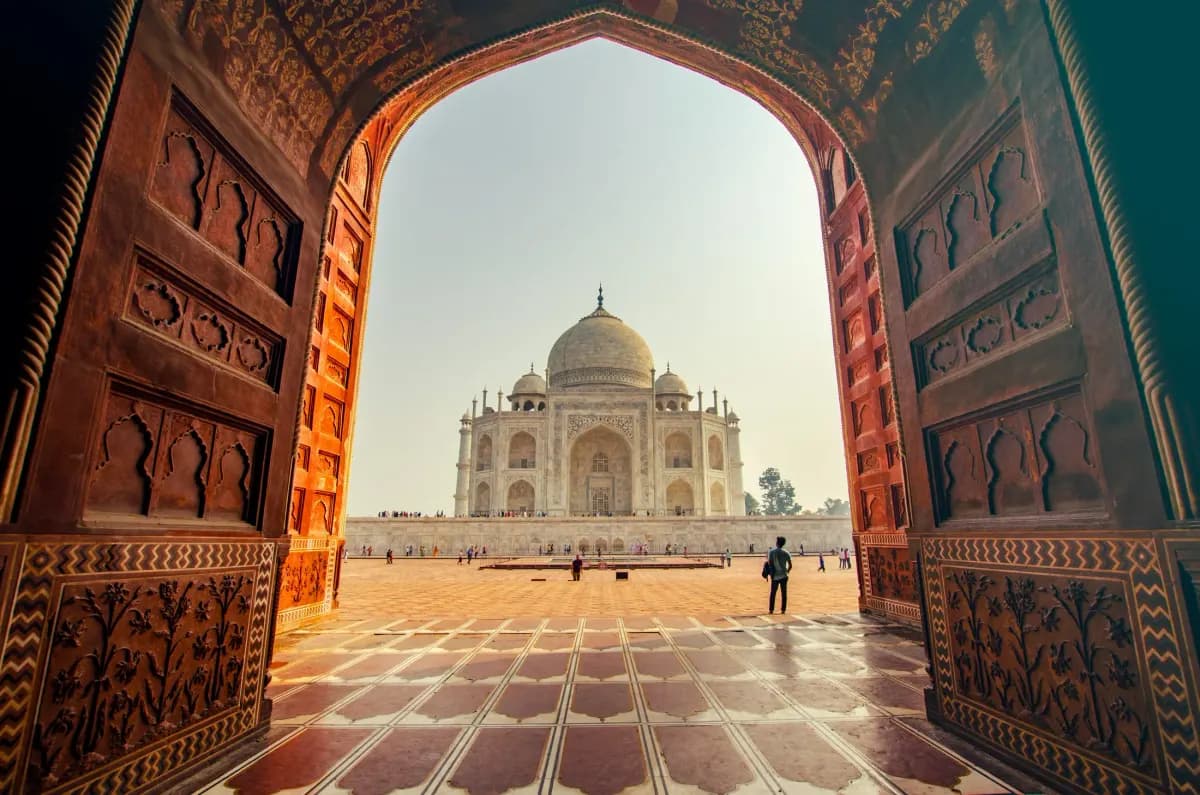
1. The Taj Mahal, Agra — Built by Emperor Shah Jahan for his wife Mumtaz Mahal and completed around 1653 after roughly two decades of construction, the Taj Mahal is that rare landmark that looks even better in person than in every photo you've already seen of it — perfectly symmetrical white marble that shifts colour with the light, from soft pink at sunrise to brilliant white at midday to warm gold at sunset. Agra Fort and the abandoned Mughal capital of Fatehpur Sikri sit nearby, both UNESCO-recognised in their own right, and reward a full day rather than a rushed photo stop before continuing on to Rajasthan. Our Taj Mahal Tours cover several ways to build Agra into a wider itinerary.
2. Delhi — India's capital is really several cities layered on top of one another: Mughal-era Old Delhi around the Red Fort and Jama Masjid, colonial New Delhi's wide avenues and government buildings, and a fast-moving modern capital surrounding both. Chandni Chowk's dense lanes of spice traders and street food stalls sit a short drive from Humayun's Tomb, the architectural forerunner to the Taj Mahal, and the Qutub Minar, the tallest brick minaret in the world. Most international itineraries begin or end here, and it rewards two or three days on its own rather than a same-day connection — often as the opening leg of our Golden Triangle Tour.
3. The Golden Temple, Amritsar — Harmandir Sahib, Sikhism's holiest shrine, sits at the centre of a sacred pool called the Amrit Sarovar and stays open around the clock, its free community kitchen serving tens of thousands of meals daily to anyone who comes, regardless of faith or background. The atmosphere itself — continuous prayer, pilgrims circling the water through the night — is what most visitors remember, more than any single view. A short walk away, Jallianwala Bagh and the daily Wagah Border ceremony add real historical weight and genuine spectacle to an Amritsar stop, covered in depth in our Spiritual India itinerary.
4. Leh & Ladakh — A high-altitude desert in India's far north, closer in landscape and Buddhist culture to the Tibetan plateau than to the rest of the country. Pangong Lake's shifting turquoise water, Nubra Valley's cold-desert sand dunes and double-humped Bactrian camels, and Khardung La — one of the highest motorable passes in the world — are genuinely unlike anywhere else on this list. Altitude means the region needs proper acclimatisation time built into any itinerary, but travellers who give it that time consistently name Ladakh the most memorable leg of their entire trip — our Ladakh Tour builds in the acclimatisation days needed to do it properly.
5. Srinagar & Kashmir — Houseboats on Dal Lake, Mughal-era terraced gardens, and alpine meadows at Gulmarg give Kashmir a character often described as India's most beautiful region — green and mountainous where much of the rest of the country is not. A night aboard one of Srinagar's ornately carved houseboats is one of the more memorable overnight experiences available anywhere in India, and Gulmarg's pine forests function as a ski destination in winter and a green retreat the rest of the year — see our Kashmir Honeymoon itinerary for a full 5-day route.
6. Rishikesh & Haridwar — The birthplace of modern yoga tourism, with white-water rafting on the Ganges alongside riverside ashrams — including the one made famous by the Beatles' 1968 visit — and a nightly Ganga Aarti fire ceremony at Haridwar's Har Ki Pauri ghat, the point where the Ganges is believed to have first touched earth. Both towns are officially vegetarian and alcohol-free, reflecting their status as centres of pilgrimage. If your dates align with early March, our International Yoga Festival guide covers the week-long event in detail.
See these North India stops combined into one route. View the Classic Golden Triangle Tour
Rajasthan's Desert Cities
7. Jaipur — The Pink City opens most Rajasthan itineraries, its Amber Fort and City Palace among the most photographed sights in the state. The fort's elephant approach and mirrored Sheesh Mahal, alongside the astronomical instruments of Jantar Mantar and the ornate façade of Hawa Mahal, give Jaipur enough depth for two full days before continuing on to the rest of Rajasthan — all covered on our Jaipur City Tour.
8. Udaipur — Built around Lake Pichola with a palace that appears to float on it, Udaipur is Rajasthan's softest, most romantic city — a deliberate change of register from the desert forts elsewhere in the state. Boat rides at sunset, the City Palace's sprawling courtyards, and a genuinely different, lake-centred rhythm make it a favourite stop for honeymooners and first-time visitors alike, as covered in our Udaipur Tour.
9. Jaisalmer — Deep in the Thar Desert, Jaisalmer Fort is a "living fort" — people still actually reside inside its honey-coloured sandstone walls, a genuine rarity among the world's major forts, with homes, shops and temples woven through its narrow lanes. Camel safaris into the surrounding dunes at sunset are a natural extension of a Jaisalmer stop.
10. Pushkar — A small, low-key holy town built around a sacred lake, home to one of India's few temples dedicated to Brahma the Creator and, each autumn, one of the world's largest camel fairs, drawing tens of thousands of traders and pilgrims. Outside fair season, it's simply a relaxed change of pace from Rajasthan's busier cities.
11. Ranthambore National Park — One of India's most reliable places to see a wild Bengal tiger, thanks to its dry, open deciduous terrain, with the added novelty of safaris passing through the ruins of a 10th-century fort inside the park itself. Its proximity to Jaipur — just a few hours by road — makes it an easy addition to any Rajasthan circuit rather than a separate trip, and our Ranthambore Tour builds in time for the fort alongside the safaris.
South India's Different India
12. Kerala Backwaters — A night aboard a traditional kettuvallam houseboat, drifting through Alleppey's palm-lined canals as village life continues along the banks, is one of the most distinctive overnight experiences available anywhere in India — a world away from Rajasthan's deserts or North India's plains. Munnar's misty tea estates and Fort Kochi's Chinese fishing nets and layered colonial history round out a Kerala circuit with genuine variety, covered in full on our Kerala Tours classic circuit.
13. Mahabalipuram — A UNESCO World Heritage site of 7th-century temples carved directly from granite outcrops on the Bay of Bengal, including the Shore Temple and the Five Rathas, an easy day trip from Chennai. Pallava dynasty sculptors carved many of these monuments straight into existing rock rather than building from quarried stone, a technique genuinely rare to see up close — our Mahabalipuram Tour covers the site in depth for travellers who want more than a rushed day trip.
14. Pondicherry — A former French colony until 1954, considerably later than most of British India, with mustard-yellow colonial villas, a boulder-lined seafront Promenade, and a noticeably slower, café-oriented pace that stands apart from the rest of Tamil Nadu. Auroville, an experimental international township nearby, adds a genuinely unusual philosophical dimension to a visit — see our Pondicherry Tour for a full day devoted to Auroville alone.
Varanasi and the Eastern Hills
15. Varanasi — Among the oldest continuously inhabited cities in the world, and the one place on this list where the destination isn't a monument but a living ritual — the evening Ganga Aarti at Dashashwamedh Ghat happens tonight exactly as it has for generations, regardless of who's watching. A sunrise boat ride past the ghats shows a completely different, quieter mood from the evening ceremony's fire and drums, and both are worth building real time around — our Heritage Tours itinerary pairs Varanasi with Khajuraho and Sarnath in a single 5-day circuit.
16. Darjeeling — Tea gardens climbing cloud-wrapped ridgelines, a UNESCO-listed narrow-gauge "toy train" completed in 1881, and sunrise views of Kanchenjunga, the world's third-highest peak, from Tiger Hill. Darjeeling tea carries a Geographical Indication status similar to Champagne — genuine Darjeeling tea can only legally come from this specific region.
The West Coast
17. Goa — 450 years as a Portuguese colony, until 1961, gives Goa a character unlike anywhere else in India, from Old Goa's UNESCO-listed churches and a distinctly Goan cuisine blending Portuguese and Konkani influences, to a genuinely relaxed beach-town pace most travellers use to close out a longer trip. North Goa's beach shacks and nightlife and South Goa's quieter upscale resorts offer two different holidays within one state. If your dates line up with the four days before Lent, our Goa Carnival guide covers the street parades that take over the state each year.
18. Mumbai — India's financial and entertainment capital, with Victorian Gothic and Art Deco architecture standing side by side along a coastline anchored by Marine Drive's sweeping curve, nicknamed the "Queen's Necklace." Chhatrapati Shivaji Maharaj Terminus, a UNESCO World Heritage railway station, and the Gateway of India both remain genuinely functional landmarks rather than purely historical ones.
Central India and the Islands
19. Khajuraho — A UNESCO World Heritage temple complex built by the Chandela dynasty between roughly 950 and 1050 CE, its surfaces covered in some of the most intricately carved stone sculpture anywhere in India — thousands of figures depicting deities, celestial beings and scenes from daily life. It sees considerably fewer visitors than the Taj Mahal or Delhi's major monuments, making for a more contemplative visit. It pairs naturally with Varanasi on our Heritage Tours itinerary, connected by a short domestic flight.
20. Andaman Islands — India's tropical frontier, a genuine outlier on this list — white sand, coral reefs and Havelock Island's beaches feel closer to Southeast Asia than to mainland India. It's the one entry here that works best as a dedicated beach-and-diving trip rather than an add-on to a heritage-focused circuit, given the flight time from most mainland gateways — see our Andaman Beach Honeymoon itinerary for a full 5-day route.
How to Actually See a Selection of These in One Trip
No first-time visitor sees all 20 of these places in a single trip, and trying to usually produces a worse experience than picking a smaller, well-connected cluster and giving each stop proper time. The classic starting combination is the Golden Triangle — Delhi, Agra and Jaipur — which alone covers three of this list's strongest entries within a manageable week, and extends naturally into the rest of Rajasthan (Udaipur, Jodhpur, Jaisalmer, Pushkar, Ranthambore) for travellers with ten days or more. Varanasi adds a spiritual dimension a short flight from Delhi or Agra, while Amritsar extends a North India itinerary further northwest. Because Rajasthan runs almost entirely on private car and driver hire rather than fixed group schedules, this entire circuit can move at whatever pace actually suits your group, lingering an extra half-day wherever something genuinely catches your interest.
Kerala, Goa, Mahabalipuram and Pondicherry work better as a separate South India coastal circuit than as an add-on to a Rajasthan-heavy trip, given the distances involved — most travellers either dedicate a full trip to South India or fold it in as a second visit rather than trying to cover the whole country at once. The Himalayan destinations — Leh & Ladakh, Srinagar & Kashmir, Darjeeling — each need their own dedicated time and, in Ladakh's case, genuine altitude acclimatisation, so they're usually best treated as their own trip or a substantial extension rather than squeezed between other stops. Mumbai and Goa pair naturally as a closing leg for almost any itinerary, given Mumbai's strong international flight connections, while Khajuraho and Central India's wildlife parks connect well to a North India trip via Delhi or Varanasi if you have the extra days.
See the South India coastal circuit as a ready-made route. View our South India Tours Classic package
Matching These Places to What You Actually Want From a Trip
If heritage and architecture are the priority, the Golden Triangle plus Rajasthan covers more genuinely significant historical sites per day of travel than almost anywhere else in the world — forts, palaces and temples spanning centuries of Rajput, Mughal and colonial history, often within a short drive of one another. If wildlife is the draw, Ranthambore pairs naturally with Rajasthan given the short distance from Jaipur, while Central India's tiger reserves — Bandhavgarh, Kanha and Pench — form their own dedicated circuit for travellers specifically prioritising safari time over monuments, covered in full in our Tiger Safari Tours guide.
Travellers drawn to mountains and genuinely different landscapes should weight their itinerary toward Leh & Ladakh, Kashmir or Darjeeling rather than trying to add a token mountain stop onto a heritage-focused trip — these destinations reward the kind of unhurried, dedicated time that's hard to fit alongside a packed Rajasthan circuit. And if beaches, relaxation and a slower pace matter most, Goa, Kerala, Pondicherry and the Andaman Islands between them offer genuinely different coastal experiences — lively nightlife, backwater stillness, French colonial charm, and tropical diving respectively — worth choosing between rather than trying to combine all four on one trip.
Frequently Asked Questions
How many of these places should a first-time visitor plan to see? 4 to 6 is realistic for a two-week trip without feeling rushed — trying to cover more usually means less time at each stop and more days lost to travel between them. A 10-day trip comfortably covers the Golden Triangle plus one or two Rajasthan cities; two weeks or more allows a fuller Rajasthan circuit or a proper South India coastal trip.
What's the best starting point for a first India trip? The Golden Triangle (Delhi, Agra, Jaipur) remains the most common and best-supported starting circuit, with well-established infrastructure, manageable travel times between each stop, and enough variety — Mughal monuments, colonial architecture, and Rajput forts — to give a genuine first impression of India's range.
Is it better to focus on one region or try to see a bit of everything? One region done properly beats a scattered itinerary trying to touch North, South and the Himalayas in a single trip — the distances and different climates make a single well-connected circuit far more comfortable and memorable than a rushed tour spanning the whole country.
Which of these places pairs best with wildlife safaris? Ranthambore fits naturally into a Rajasthan circuit given its proximity to Jaipur, while Kerala and Goa itineraries can extend into Central India's tiger reserves for travellers specifically prioritising wildlife over a purely heritage-focused trip.
What time of year suits most of these destinations? October through March offers the most comfortable weather across the majority of this list — Rajasthan, the Golden Triangle, Varanasi and South India all see their most manageable temperatures in these months. Summer brings intense heat to the plains and deserts, while the Himalayan destinations have their own separate, narrower travel windows tied to snow and road access.
Should we book a private guide and driver, or travel independently? Most of these destinations — particularly Rajasthan's forts, Varanasi's ghats, and Ladakh's high-altitude routes — are considerably richer with a private, English-speaking guide and driver rather than navigating independently. It's also the standard way international visitors travel most of this list, rather than an optional upgrade.
Are any of these 20 places suitable for a short 5 to 7 day trip? Yes — the Golden Triangle alone (Delhi, Agra, Jaipur) fits comfortably into 5 to 7 days, or a Rajasthan-only trip covering Jaipur, Pushkar and Udaipur works nearly as well in that window. Anything involving the Himalayan destinations or a wider multi-region circuit generally needs closer to two weeks to feel unrushed.
Bringing It All Together
Weather also shapes how these 20 places fit together more than most first-time visitors expect. Rajasthan, the Golden Triangle and Varanasi are all considerably more comfortable October through March, while Kerala's backwaters can be visited nearly year-round, with the June-to-September monsoon bringing the landscape's most vividly green season rather than ruling out a visit entirely. Ladakh's travel window is narrower still — realistically June through September, since both overland routes into the region close outside those months — which is worth factoring in early if a Himalayan leg is part of your plan, since it may constrain when the rest of your trip can happen around it.
The real value of a list like this isn't seeing every entry — it's using it to recognise how different India's regions genuinely are, and building an itinerary around a handful that complement each other rather than a scattershot tour of famous names. If you're not sure which of these fit together well for your available time, tell us how many days you have and what draws you most — heritage, wildlife, mountains, or the coast — and we'll put together a route built around the right combination rather than trying to fit all 20 into one trip.
Dhruv Poonia is the Digital & Marketing Manager for Colourful Indian Holidays, working alongside a family travel business that has arranged tours across India, Nepal and Bhutan since 2007. He also oversees the company's sister sites, Rajasthan Travel Agency and Palace on Wheels Tour.
He writes and maintains the destination guides, route information and travel advice published on this site, drawing on his day-to-day work planning itineraries for international travellers to keep every page accurate and current.
Start Your Journey
Your India Journey Awaits.
Where Will You Begin?
Tell us how many days you have and what draws you most — we'll reply with a tailored itinerary and quote, usually within 24 hours.