Top Cultural Festivals in India
From camel fairs in the desert to a fire ceremony on the Ganges — here's when India's biggest festivals actually happen, and what timing a trip around one really involves.
By Dhruv Poonia, Digital & Marketing Manager, Colourful Indian Holidays · Published 20 September 2026 · Updated 21 September 2026
Already know you want this trip? Skip ahead and tell us your dates.
India runs on a lunar and agricultural calendar as much as a solar one, which means most of its biggest festivals don't fall on a fixed Gregorian date — they shift by a few weeks each year, and knowing roughly when to expect them is the difference between building a trip around one deliberately and missing it by a week without realising. Beyond the calendar problem, most first-time visitors also underestimate just how different India's major festivals are from one another. Some are single-evening spectacles concentrated in one city; others run for a week or more and shift character as they build toward a climax; a few aren't tied to a single date at all, and one — Kumbh Mela — happens so rarely at any given location that most people alive today will only get the chance to see a particular host city host it once or twice in their lifetime.
Below is a season-by-season guide to the festivals we get asked about most often by international travellers, organised the way we'd actually plan a trip around them rather than as a simple alphabetical list. For each one, we've tried to be honest about what a visit genuinely involves — the crowds, the logistics, how much advance planning is realistic, and how well it combines with the rest of a wider India itinerary — rather than just describing the festival in the abstract. If you're weighing up whether to build an entire trip around one of these dates or simply hoping to catch one along the way, this should give you enough to decide.
Winter (November–February)
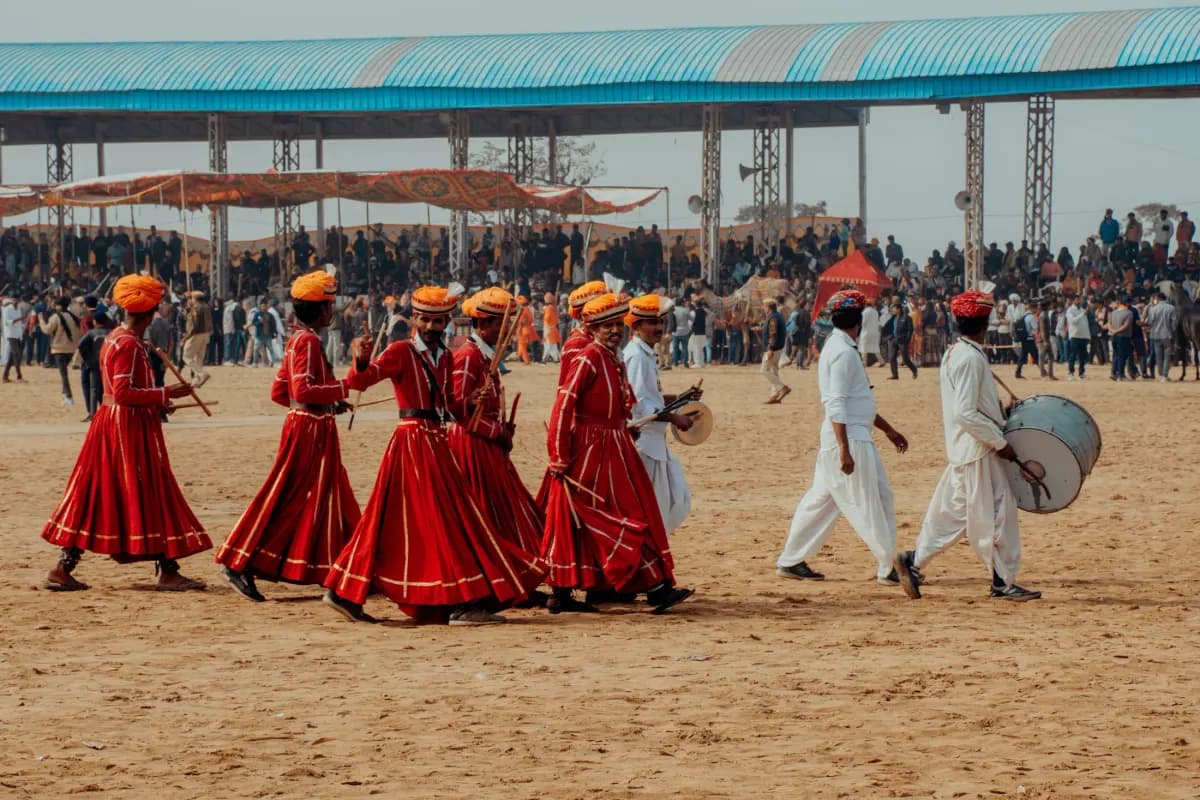
Winter is India's most comfortable travel season generally — cool, dry, and considerably easier on visitors than the heat of April through June — and it happens to host several of the country's largest festivals. The Pushkar Fair is the standout: one of the largest camel and livestock fairs anywhere in the world, drawing tens of thousands of traders and their animals to the desert outside Pushkar over a roughly week-long period. What began centuries ago as a practical trading event has grown into a genuine cultural festival layered on top of that original commerce — camel races, decoration competitions and tug-of-war matches now run alongside the everyday business of buying and selling livestock, and the whole thing coincides with a significant Hindu pilgrimage period at Pushkar's sacred lake, meaning visitors experience two genuinely distinct events happening in the same town at the same time.
A few hours away in Bikaner, the Camel Festival takes a more purely celebratory approach. Where Pushkar's fair grew organically out of livestock trading, Bikaner's festival was deliberately created as a cultural showcase by the Rajasthan tourism department, opening with a procession of elaborately decorated camels through the city from the grounds of Junagarh Fort, and filling its two days with camel-specific competitions, folk music, fire dances and puppet shows. It's a smaller, more curated event than Pushkar's sprawling fair, and the two are genuinely different enough that we sometimes get asked whether they're the same festival — they aren't, though both happen within a similar winter window and can occasionally be combined if your dates and travel time allow, particularly as part of a wider Rajasthan tour.
Further west in Gujarat, the Kutch Mahotsav (also widely known as the Rann Utsav) takes a completely different approach to timing — rather than a fixed week, it runs across the entire winter season, from roughly November through February, coinciding with the months when the Great Rann of Kutch's salt marsh dries into a blinding white desert and camping on its edge is genuinely comfortable. A purpose-built tented camp, ranging from simple to genuinely luxurious, hosts visitors for the full season, with Kutchi folk performances and craft traditions — embroidery, leatherwork, metalwork — showcased throughout. Because it runs for months rather than days, it's one of the most flexible festivals on this list to build into a trip on whatever schedule suits you. See our Gujarat destination guide for more on the wider state.
Holi — The Festival of Colours (Usually March)
No list of Indian festivals would be complete without Holi, probably the single most internationally recognisable Hindu festival, celebrated with coloured powder and water thrown freely between friends, family and strangers alike in a genuinely joyful, chaotic public celebration. Holi marks the arrival of spring and, in Hindu mythology, the triumph of good over evil, commemorated through the story of Holika and Prahlad. The night before the main colour celebration, communities light bonfires — Holika Dahan — symbolising the burning away of evil, before the following morning erupts into the colour-throwing most visitors picture when they think of the festival.
Mathura and Vrindavan, the towns traditionally associated with Krishna's childhood, hold some of the most elaborate and extended Holi celebrations in the country, sometimes running for over a week with different local variations each day. Jaipur is a genuinely practical alternative for visitors already following a Rajasthan itinerary, and — as covered separately below — often pairs directly with the Elephant Festival, held the evening before. Whichever city you choose, a few practical points are worth knowing in advance: wear clothes you're fully prepared to ruin, protect your eyes and any electronics, and expect the celebration to be considerably more physical and unpredictable than a typical festival — genuinely part of the appeal for most visitors, but worth being mentally prepared for rather than surprised by.
Time a trip around Holi or another festival specifically? See our Festival Tours
Late Winter into Spring (February–March)
As winter turns to spring, the festival calendar shifts character entirely, moving away from the desert and toward the coast and the Himalayan foothills. Goa Carnival runs for four days just before the start of Lent on the Christian calendar, a Portuguese colonial-era tradition — Goa was held by Portugal for over 450 years — that has become genuinely Goan in its own right rather than remaining a foreign import. Street parades featuring elaborately decorated floats move through Goa's towns, accompanied by live bands, costumed dance troupes and performers in vivid, feathered outfits reminiscent of Brazilian carnival traditions, giving Goa a street- party atmosphere genuinely distinct from the rest of India's more ritual-based celebrations. See our Goa destination guide for more on the state itself.
Around the same period, Jaipur's Elephant Festival is held on the eve of Holi, adding a distinctly Rajasthani royal tradition to a period already busy with celebration across the city. Elephants painted with intricate traditional patterns process through the city in a practice with roots in Jaipur's royal history, when the Maharajas' elephants were similarly adorned for ceremonial occasions — and because it falls the evening before Holi itself, many visitors experience both events back to back on the same trip. The International Yoga Festival in Rishikesh also runs in early March, drawing yoga teachers, practitioners and students from dozens of countries to a city widely regarded as the birthplace of modern yoga tourism. Multiple simultaneous tracks — Hatha, Ashtanga, Kundalini and others — run throughout the week alongside meditation and Ayurveda workshops, many held directly on the banks of the Ganges with the Himalayan foothills as a backdrop.
Monsoon Season (July–September)
Fewer international visitors travel during India's monsoon months, largely for practical reasons — heavier rain, higher humidity, and reduced visibility in hill regions — but two genuinely significant festivals fall in this window regardless, and both are worth knowing about even if you ultimately choose a different season for the bulk of your trip. Rajasthan's Teej Festival marks the arrival of the monsoon itself, with a royal procession — historically organised by the Maharajas — moving through Jaipur's old city with decorated elephants, camels and traditional musicians. Women celebrate in traditional green dress specifically, a colour chosen to reflect the fresh growth the rains bring after months of dry heat, and courtyards across the city fill with flower-decorated swings used for a customary swinging ritual associated with the celebration. In Hindu tradition, the festival also marks the reunion of the goddess Parvati with Shiva, giving it particular significance for married and unmarried women, who traditionally observe fasts and prayers for marital wellbeing around the same period.
In Kerala, the ten-day Onam harvest festival builds gradually toward its climax rather than concentrating everything into a single day. Rooted in the legend of King Mahabali, a benevolent mythical ruler whose annual return to visit his former subjects the festival commemorates, each of the ten days carries its own name and rituals. The pookalam — an intricate flower carpet laid at doorsteps each morning — grows more elaborate as the days progress, Vallam Kali snake boat races draw large crowds to the backwaters, with the Nehru Trophy Boat Race at Alappuzha the most famous, and the festival closes with the Onam Sadhya, a traditional vegetarian feast running to well over twenty dishes served together on a single banana leaf. Because Onam spans ten days rather than one, it offers genuine flexibility that most single-day festivals simply don't. See our Kerala destination guide for more on planning a trip around it.
Autumn — Diwali (October–November)
Diwali, the festival of lights, is India's largest and most widely celebrated festival, observed by Hindus, Sikhs and Jains across the country, each tradition attaching its own significance to the occasion — broadly, the triumph of light over darkness and good over evil. The main celebration falls on a single night determined by the lunar calendar, typically in October or November, but the surrounding festival period spans roughly five days, each with its own smaller traditions building up to and following the main night itself.
The festival's visual signature is light itself — diyas, small clay oil lamps, lit in vast numbers across homes, temples, shops and public spaces, joined in recent decades by string lights and, in many cities, fireworks, though fireworks restrictions have tightened in several major cities in recent years for air-quality reasons. For visitors, the most striking way to experience Diwali is through the cities that put on the most elaborate public displays rather than through private family celebrations, which remain the festival's core but are naturally less accessible to outside visitors. Varanasi's ghats, already among the most atmospheric settings in India, become especially striking during Diwali, lit with thousands of lamps along the Ganges — a highlight of our Heritage Tours itinerary. Amritsar's Golden Temple takes on a similarly striking character, illuminated and reflected in its surrounding pool in one of the most photographed Diwali scenes anywhere in the country, and features in our Spiritual India itinerary alongside Haridwar and Rishikesh. Jaipur and Delhi also light up significantly during the festival, making either a reasonable alternative for travellers whose itinerary doesn't extend to Varanasi or Amritsar specifically.
Rotating & Once-in-a-Lifetime Festivals
A handful of festivals don't fit a neat annual calendar at all, and understanding why matters for planning around them. Kumbh Mela is widely considered the largest peaceful gathering of human beings anywhere on Earth, drawing tens of millions of pilgrims to bathe at a sacred river confluence during a window determined by Hindu astrology rather than a fixed calendar date. The festival rotates between four cities — Haridwar and Prayagraj on the Ganges, Ujjain on the Shipra, and Nashik on the Godavari — with each hosting roughly once every twelve years, and the largest editions, held at Prayagraj, have recorded attendance estimates running into the hundreds of millions across the full festival period. The central ritual is snana, ritual bathing at astrologically determined auspicious moments, and the festival draws striking processions of Naga Sadhus, ash-covered ascetic holy men who appear publicly at Kumbh Mela in a centuries-old tradition.
On a smaller but no less significant scale, the Urs Festival at Ajmer Sharif Dargah marks the death anniversary of the 12th-century Sufi saint Khwaja Moinuddin Chishti, whose shrine has drawn pilgrims for over 800 years. In Sufi tradition, a saint's death anniversary is understood as a union with the divine rather than a day of mourning, which gives the Urs its genuinely celebratory character — six days of devotional gathering built around qawwali, a devotional form of Sufi music performed live at the shrine each night, often continuing well into the night with growing intensity. What distinguishes the Urs from many religious festivals is how genuinely open it is — the Dargah draws visitors and pilgrims of multiple faiths, reflecting the shrine's long history as a site of shared devotion across religious lines.
Frequently Asked Questions
How far in advance do we need to plan a trip around a specific festival? For most of the festivals above, three to six months is a sensible window — enough time to confirm exact dates once they're published for your travel year, and to book accommodation before prices rise. Kumbh Mela is the clear exception: given the crowd sizes involved and the years-ahead astrological calculation behind its timing, planning at least a year in advance is genuinely worthwhile if a specific edition is your priority.
Can we combine more than one festival in a single trip? Sometimes, if the dates line up and the festivals sit reasonably close together — the Elephant Festival and Holi in Jaipur are a natural pair given they fall on consecutive days, and Pushkar Fair and the Camel Festival occasionally align closely enough to combine with extra travel time. As a general rule, though, we'd recommend building a trip around one festival properly rather than trying to chase several, since the travel time between festival locations usually eats into the time you'd otherwise spend actually experiencing each one.
Are these festivals safe and comfortable for solo travellers or families? Generally yes, though crowd density varies enormously — a quiet morning at the Kutch Mahotsav tented camp is a completely different experience from being in the middle of a Holi street celebration or the peak days of Kumbh Mela. We can advise on which festivals suit a lower-key visit versus a full-immersion experience based on your travel style and who you're travelling with.
Do these festivals affect flight and hotel prices? Yes, noticeably, in the towns and cities directly hosting a major festival. Hotel rates in Pushkar during the fair, in Varanasi and Amritsar around Diwali, and in any Kumbh Mela host city during the festival period can rise significantly compared to the rest of the year, and availability tightens well before the dates themselves. Booking as early as your travel plans allow is genuinely the best way to avoid both problems.
Realistically Planning Around a Festival
- Confirm exact dates as early as possible — most of these festivals shift by weeks year to year, and several (Pushkar, Diwali, Onam, Teej, Holi, the Urs) follow lunar calendars rather than fixed Gregorian dates.
- Book accommodation well ahead of any confirmed festival date — hotels in festival towns fill and prices rise significantly in the weeks before.
- One festival integrated naturally into a wider itinerary works better than trying to time a trip around several — Pushkar Fair pairs easily with Rajasthan, Onam with a Kerala circuit, Diwali with Varanasi or Amritsar specifically.
- Kumbh Mela is a genuine exception to casual planning — crowd sizes reach tens of millions on the most auspicious days, and a private guide with direct knowledge of the specific host city and bathing schedule is close to essential.
- Pack accordingly — light, easily washable clothing for Holi, modest dress covering shoulders and knees for temple and shrine visits at the Urs or the Golden Temple, and warm layers for winter desert festivals like Pushkar and Kutch Mahotsav, where nights can turn genuinely cold despite warm daytime temperatures.
Most of these festivals can be built into a wider Rajasthan or North India itinerary without much extra travel, since several of the biggest — Pushkar, the Camel Festival, Teej, Holi and the Elephant Festival — all happen within the same state. If you'd like a trip built specifically around one of these dates, or a festival woven into a longer route you're already planning, our Festival Tours page rounds up every festival covered here in one place, or our team can put together an itinerary that fits your travel window directly.
Dhruv Poonia is the Digital & Marketing Manager for Colourful Indian Holidays, working alongside a family travel business that has arranged tours across India, Nepal and Bhutan since 2007. He also oversees the company's sister sites, Rajasthan Travel Agency and Palace on Wheels Tour.
He writes and maintains the destination guides, route information and travel advice published on this site, drawing on his day-to-day work planning itineraries for international travellers to keep every page accurate and current.
Start Your Journey
Time Your Trip Around an Indian Festival.
When Will You Go?
Every itinerary is built privately around your dates and interests — tell us which festival you'd like to catch and we'll reply within 24 hours.