Taj Mahal Visiting Guide
Tickets, timings, the Friday closure, sunrise versus sunset, and the small decisions that make the visit go well.
By Dhruv Poonia, Digital & Marketing Manager, Colourful Indian Holidays · Published 28 September 2026
Already know you want this trip? Skip ahead and tell us your dates.
The Taj Mahal is the reason many people plan a trip to India, and it is easy to get a few small things wrong: arriving on a Friday when it is closed, queuing at the wrong gate, or choosing a time of day that leaves you in a crowd. This guide covers what you need to plan the visit well. It is based on the official Taj Mahal information at the time of writing, but prices and rules change, so check the official sites before you go.
The Essentials at a Glance
- Closed: every Friday, to general visitors.
- Open: the other six days, from around sunrise to around sunset, so the hours shift through the year.
- Foreign visitor ticket: 1,100 rupees for the complex, plus an optional 200 rupees for the main mausoleum chamber, as of our latest check.
- Children: free under 15.
- Time to allow: two to three hours.
- Bring: your passport or another photo ID, and only what you need.
What Are the Taj Mahal's Opening Hours?
The monument opens about half an hour before sunrise and closes about half an hour before sunset, so the exact times change with the seasons. The ticket counters open earlier, one hour before sunrise, and close 45 minutes before sunset. Because security screening happens before you go in, arrive well ahead of the time you want to be inside.
The Friday closure is the single most important thing to plan around. The Taj Mahal is closed to general visitors every Friday, when the mosque within the complex is used for prayers. If you are building a trip around Agra, put your Taj visit on any other day and make Friday a travel day or a day for other sights. On our Golden Triangle routes we schedule the Agra stop around this before anything else.
How Much Are Tickets, and How Do You Book Online?
Ticket prices depend on nationality. Foreign visitors from outside the SAARC and BIMSTEC countries pay 1,100 rupees, which is roughly sixteen US dollars once the optional 200-rupee mausoleum ticket is added. The mausoleum ticket lets you go inside the main chamber that holds the cenotaphs of Mumtaz Mahal and Shah Jahan, and it is a separate add-on rather than part of the base price. Children under 15 enter free.
You can buy tickets at the gates, but booking online through the official Taj Mahal website or the Archaeological Survey of India's ticketing portal is quicker and carries a small discount for foreign visitors. Stick to the official channels; third-party sellers often charge considerably more and sell nothing you cannot get directly. The foreigner ticket also includes a bottle of water, shoe covers and a map, and battery-bus and golf-cart rides within the approach area are free with it. If you book a tour with us, tickets are handled for you, so you skip this step.
Skip the ticket queue entirely. See our Taj Mahal Tours
Which Gate Should You Use?
There are ticket counters at the Eastern and Western gates, and the queues for foreign and domestic visitors are separate, with signs to direct you. The southern gate is currently exit-only. The Western Gate, near the city side, is the one most organised tours use, while the Eastern Gate is convenient if you are staying in the Taj Ganj area close to the monument. Your driver or guide will know which is quicker on the day, since queue lengths vary.
Sunrise, Daytime or Sunset
Sunrise is the most popular choice and for good reason. The light is soft, the air is cool in the cooler months, and the monument shifts through pale colours as the sun comes up. It is also usually quieter than midday, though popular mornings still draw crowds at the gate. The catch is that fog can settle over Agra in the winter, particularly in December and January, and can hide the monument at dawn, so sunrise is a gamble in those months.
Sunset is a good alternative if you prefer not to start early, with warm colour on the marble and the crowd starting to thin. Midday is the least pleasant for light and heat, and the harshest for photographs. A sensible plan is to visit at one end of the day and spend the middle of it elsewhere. Our Photography Tours build whole days around this principle.
Can You Visit the Taj Mahal at Night?
The Taj Mahal can be seen by moonlight, but only on a handful of nights around the full moon, in small, timed groups, and with tickets that must be bought in advance. It is a limited experience rather than a regular option, and the schedule changes, so if it matters to you, check the official site as early as you can and plan your dates around it rather than hoping to add it on the spot.
What to Bring and What to Leave Behind
Security at the gate is thorough, and the simplest rule is to bring only what you need. Carry your passport or another form of photo ID, a phone or camera, water and a small bag. Drones are strictly prohibited. Large bags and various other items are commonly restricted, so it is worth checking the current list on the official site and leaving anything unnecessary at your hotel. Dress comfortably and modestly, wear shoes that are easy to slip off if you go inside the mausoleum, and expect a walk of some length from the gate to the main platform.
Mehtab Bagh: The View From Across the River
Many visitors add a second viewpoint on the opposite bank of the Yamuna, in the gardens known as Mehtab Bagh. From there you see the Taj Mahal across the water rather than from inside its own grounds, which gives a different composition and a useful option late in the day. It works well as a supplement to a visit rather than a replacement for one.
The Story Worth Knowing Before You Go
The Taj Mahal was built by the Mughal emperor Shah Jahan as a tomb for his wife, Mumtaz Mahal. The main mausoleum was completed around 1648 and the wider complex of gardens, mosque and guest houses around 1653. Knowing a little of this makes the visit richer, because the symmetry, the calligraphy and the marble inlay all carry meaning that is easy to miss on a first walk-through. A guide is the easiest way to get that, which is why a private guide is part of our itineraries.
Beyond the Taj: Making the Most of Agra
Most visitors give Agra one night, and that is enough for the Taj Mahal and Agra Fort, the Mughal fortress that stands on the same river. If you want to see the monument from your room, choose a hotel with a Taj view; our Luxury India Tours include one deliberately. For couples, our Taj Mahal Honeymoon builds a trip around it, and our Agra destination guide covers the city itself. Our Taj Mahal Tours page shows the fixed itineraries we run.
What You Are Looking At Inside the Complex
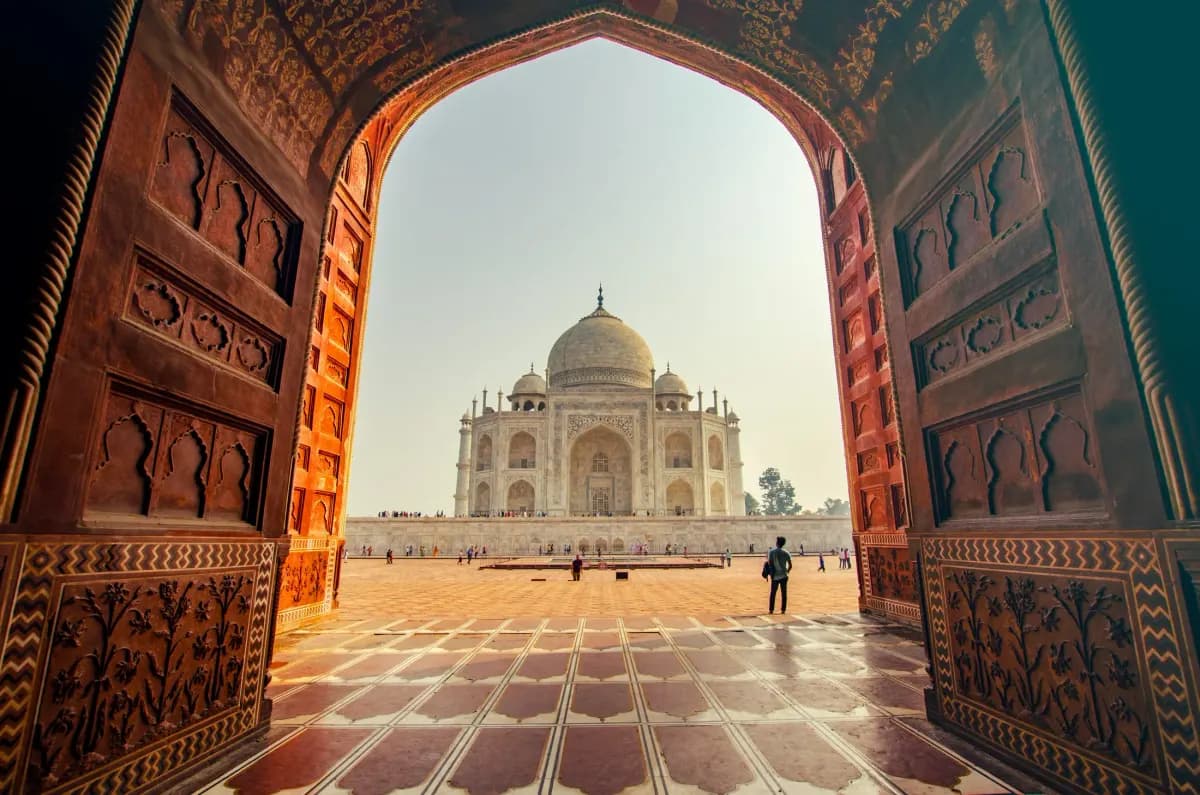
It helps to know the layout before you arrive. You enter through a monumental red sandstone gateway, and the first view of the mausoleum framed in its arch is the moment most people remember. Beyond it lie formal gardens laid out in the Mughal four-part style, divided by water channels and a long reflecting pool that doubles the monument on a still morning. The white marble mausoleum stands on a raised platform with a minaret at each corner, and to either side sit two red sandstone buildings, a mosque and a matching structure that balances it. The symmetry is deliberate, and once you notice it, it is hard to stop seeing.
A Sample Sunrise Morning
A typical sunrise visit begins well before dawn, with a short transfer from your hotel to the gate. You queue for security, walk through the entrance gateway as the light starts to build, and spend the first half hour in the gardens and along the reflecting pool while the marble changes colour. You then climb to the platform and, if you have bought the extra ticket, go inside the mausoleum, where the stairs are narrow and the chamber is dim. Most people are back at their hotel for breakfast by mid-morning, with the rest of the day free for Agra Fort or a long rest, which is the main advantage of doing it early.
How Do You Avoid the Crowds?
No time of day is empty, but some are better than others. Arriving at opening is the most reliable way to have a calmer visit, and late afternoon is the next best. Because the monument is closed on Fridays, the days either side of it tend to be busier, so if you have a choice, a mid-week visit is generally easier. Buying your ticket online saves you the counter queue, and going in a small group with a guide who knows the route through the gate helps too. Even at its busiest, the monument is large enough that the crowd thins out once you move past the main platform and into the gardens.
Photography Tips
The most famous composition is the straight-on view down the reflecting pool, and it is worth taking early, before the crowd fills the foreground. After that, move around: the gateway framing, the side views from the mosque side, and close-ups of the inlay work all give very different pictures. Wide lenses suit the gateway shots, while a longer lens picks out detail on the minarets. Soft early light is far easier to work with than the flat glare of midday, and a still morning gives the best reflections. Drones are prohibited, and it is worth checking the current rules on other camera equipment before you go.
Comfort, Heat and Health
You will spend a couple of hours on your feet with little shade in the open sections, so wear comfortable shoes, bring water and use sun protection, especially outside the cooler months. The walk from the gate to the platform is longer than it looks, and the mausoleum stairs are narrow, which may be a consideration if anyone in your group has mobility difficulties. If you are unsure how the heat or a long day will affect you, our health and vaccination guide covers sensible precautions.
How Do You Get to Agra?
Agra is roughly 230 km from Delhi, about three and a half to four hours by road along the expressway, and about 240 km from Jaipur, around five hours. Most travellers go by private car, which lets you time the arrival for the light, and some take a fast train from Delhi and stay overnight. Our guide to getting around India compares the options in more detail.
If You Only Have a Few Hours in Agra
Some itineraries pass through Agra on a single day, driving in from Delhi and out to Jaipur by evening. It is possible, but it makes for a long day, and the Taj Mahal is usually the only thing you will see properly. If time is short, prioritise the monument at the best light you can manage, add Agra Fort only if energy allows, and leave shopping stops for another trip. If you can spare a night, the visit becomes far more relaxed, because you can see the monument at sunset one day and sunrise the next, without rushing either.
Rather not squeeze it into one rushed day? See our paced 6-day Golden Triangle route
Common Mistakes
- Arriving on a Friday, when the Taj Mahal is closed.
- Leaving the visit to midday, in the heat and the crowds.
- Booking a sunrise visit in December or January without a backup plan for fog.
- Buying tickets from an unofficial seller and paying far more than the official price.
- Bringing a large bag or a drone and being turned away or delayed at security.
- Rushing in under an hour. Allow two to three.
Planning Your Trip Around It
Most travellers see the Taj Mahal as part of the classic Delhi, Agra and Jaipur circuit, and it is usually the first big sight of the trip. If you are visiting from overseas, our e-Visa guide explains the paperwork, and our Rajasthan itinerary guide shows how to extend the trip beyond Agra. Whatever route you choose, tell us your dates and we will schedule the Taj Mahal visit for the best available day and time.
Dhruv Poonia is the Digital & Marketing Manager for Colourful Indian Holidays, working alongside a family travel business that has arranged tours across India, Nepal and Bhutan since 2007. He also oversees the company's sister sites, Rajasthan Travel Agency and Palace on Wheels Tour.
He writes and maintains the destination guides, route information and travel advice published on this site, drawing on his day-to-day work planning itineraries for international travellers to keep every page accurate and current.
Start Your Journey
Ready to See the Taj Mahal?
Tell Us Your Dates.
We will schedule your visit around the Friday closure and the best light, with tickets and a private guide arranged — reply within 24 hours.